Film 210: Larger Story Forms
In this lesson, you’ll learn:
- The different structural approaches available to organize your stories
- How story structure evolved from classical to modern frameworks
- The variety of ways successful films and shows are organized
- How to choose structural approaches that serve your story’s purpose
- How WOARO works within any structural framework you select
Let’s begin!
Why Study Different Structural Approaches
You've explored WOARO—the fundamental building blocks of storytelling. Now it's time to explore how these elements can be organized into larger story frameworks.
Think of story structure like a bridge that carries your audience across the expanse of your narrative. You can build a suspension bridge, an arch bridge, or a beam bridge—each uses different principles and works better for different spans. But whatever design you choose, it needs solid construction or the whole thing collapses, leaving your audience stranded.
Understanding different structural approaches gives you options for how to carry your audience safely from beginning to end.
Classical Foundations
Aristotle’s Poetics
Aristotle laid the foundation for dramatic theory in the West with his systematic analysis of what makes stories work.
His principles from Poetics still influence storytelling today:
- Complete structure - Stories must have a clear beginning, middle, and end that form a unified whole
- Unity of action - The plot should follow one main storyline where each event connects causally to the next
- Simple vs. complex plots - Simple plots create change through straightforward progression, while complex plots include reversals (unexpected turns) or recognition (discoveries that change everything)
Freytag’s Pyramid (1863)
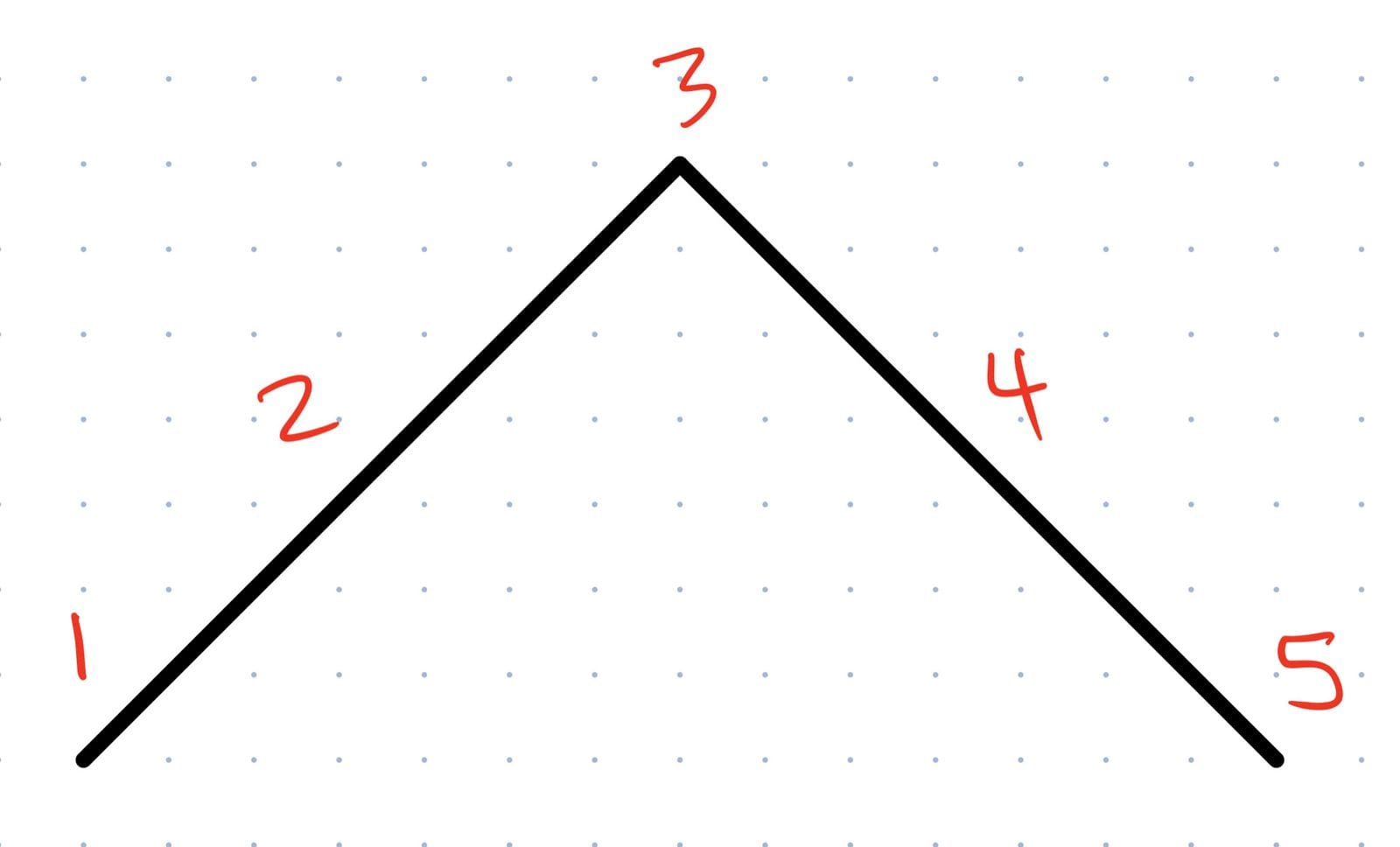
The German playwright Gustav Freytag wrote Die Technik des Dramas, mapping the 5-act dramatic structure into what became known as Freytag’s pyramid:
- Exposition (initially called introduction)
- Rising action (rise)
- Climax
- Falling action (return or fall)
- Catastrophe, denouement, resolution, or revelation
From Five to Three Acts
Freytag’s pyramid worked well for classical tragedies like Shakespeare’s plays, where you can clearly see the five-act structure in works like Hamlet or Macbeth.
But as theater evolved, playwrights began experimenting with fewer acts. Modern plays often condensed into three acts or even eliminated act breaks entirely, finding that audiences responded better to tighter, more focused structures.
Modern Screenplay Structure
Studio System Development (1930s-1960s)
Hollywood inherited these evolving theatrical ideas but faced new challenges: different audience expectations, commercial pressures, and cinema’s unique storytelling capabilities. The studio system developed practical three-act approaches influenced by:
- European filmmakers who brought sophisticated narrative techniques
- Broadway writers who moved to Hollywood and adapted stage experience
- Pulp fiction traditions that emphasized strong hooks and clear story progression
- Commercial necessities - films needed to work for mass audiences and fit exhibition schedules
Through decades of trial and error, producers like Irving Thalberg and writers like Ben Hecht developed informal guidelines about pacing and structure that became industry standard.
Syd Field’s Screenplay Structure (1979)
Field’s book Screenplay revolutionized how writers approach film structure by making the abstract concept of “three acts” practical and specific. Rather than inventing it, Field systematized what Hollywood had already developed through decades of practice.
Field’s key innovation: Breaking structure into manageable, functional units:
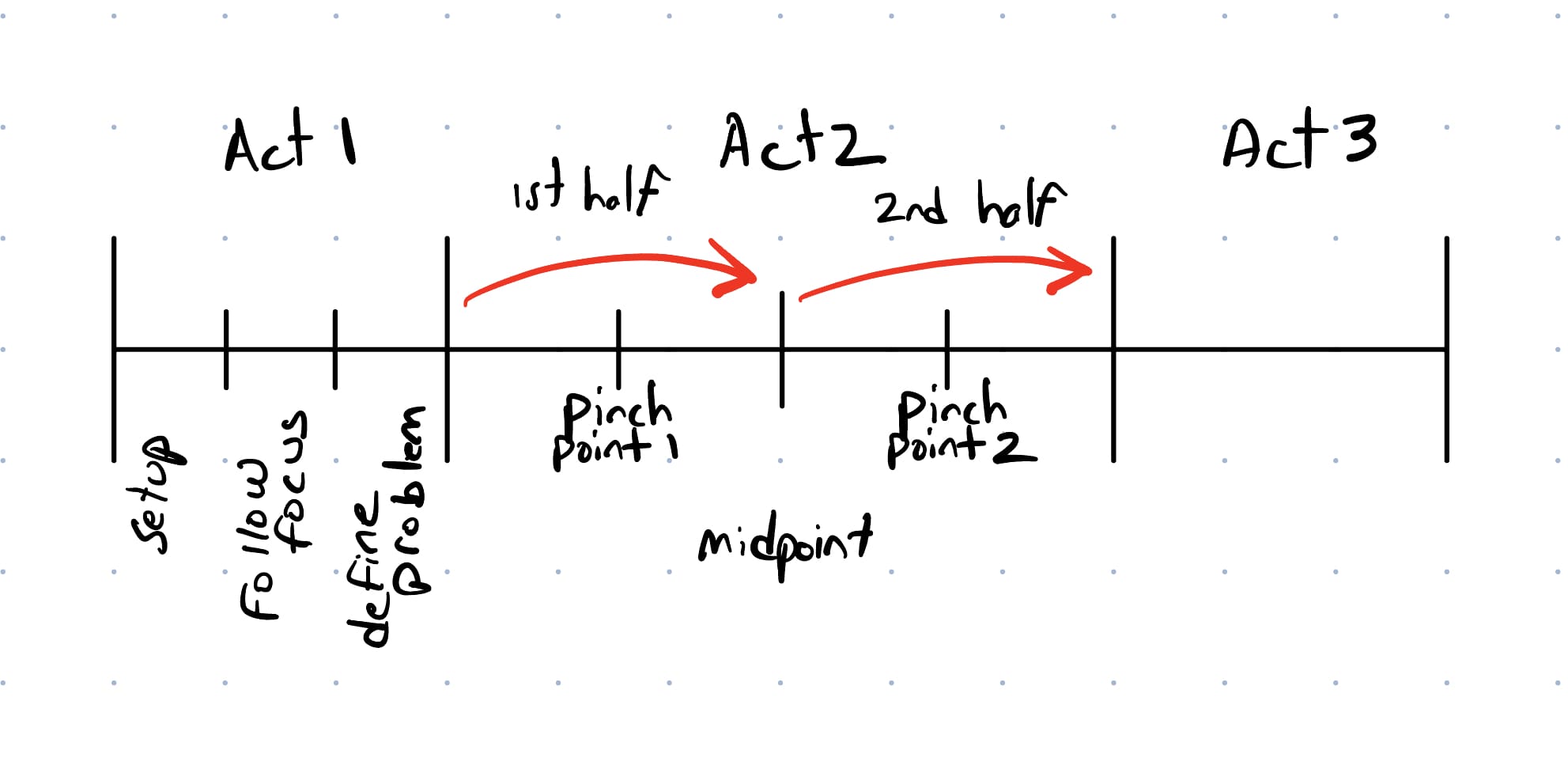
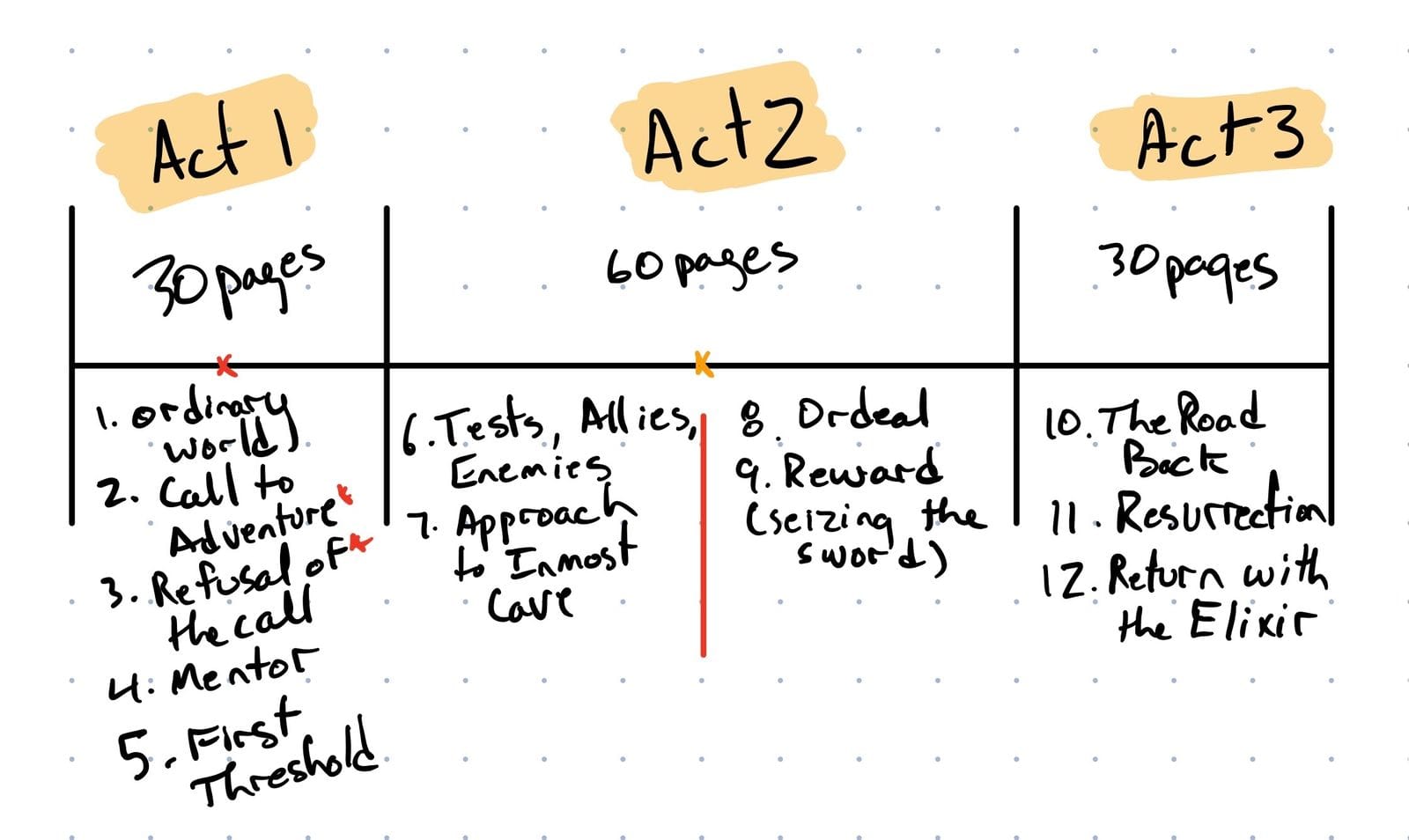
- Three-act framework (30/60/30 pages) with plot points at key moments
- Act 1 is subdivided into three 10-page sections, each with a clear purpose
- Act 2 is split in half by the midpoint - a crucial moment that “guides you and keeps you on course”
- Pinch points added to maintain story momentum
Field showed writers exactly what should happen when, transforming large structural challenges into smaller, achievable pieces. This practical approach influenced virtually all subsequent screenplay structure thinking.
Christopher Vogler’s Writer’s Journey (1992)
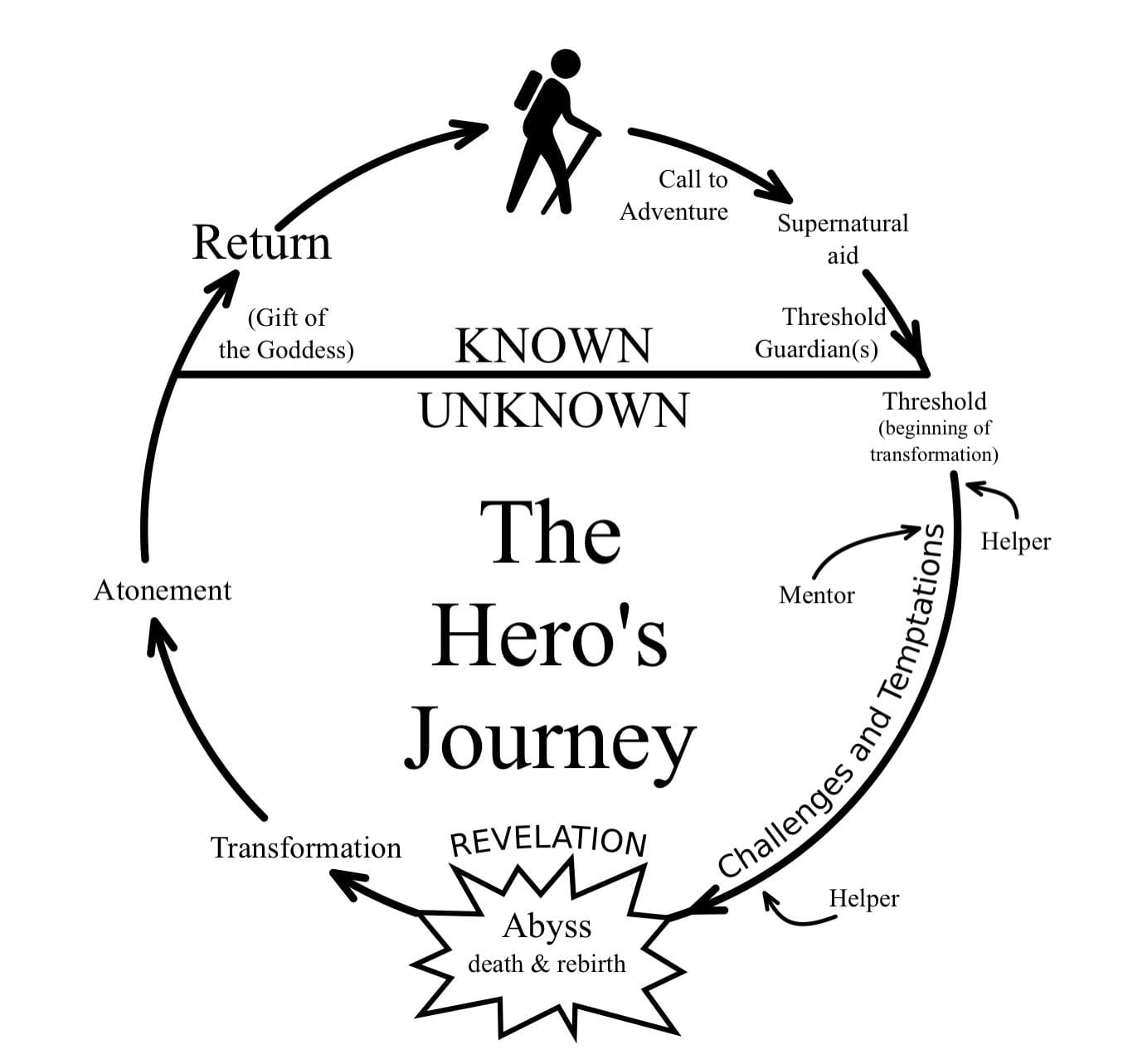
Vogler’s innovation was adapting Joseph Campbell’s mythological research—and his book The Hero With a Thousand Faces—into practical storytelling language. He took the abstract concept of the “monomyth” and gave writers specific, usable terminology.
Vogler’s key contributions:
- Circular structure emphasizing character transformation - the hero returns changed
- Clear terminology for story stages: Ordinary World, Call to Adventure, Crossing the Threshold, Mentors, Tests and Allies, The Road Back
- Two-world framework - Ordinary World vs. Special World, making the journey structure concrete
- Universal applicability - showing how mythic patterns work across genres and stories
Vogler gave writers a vocabulary to discuss character arcs and story progression that transcended specific genres, making the Hero’s Journey accessible to modern screenwriters.
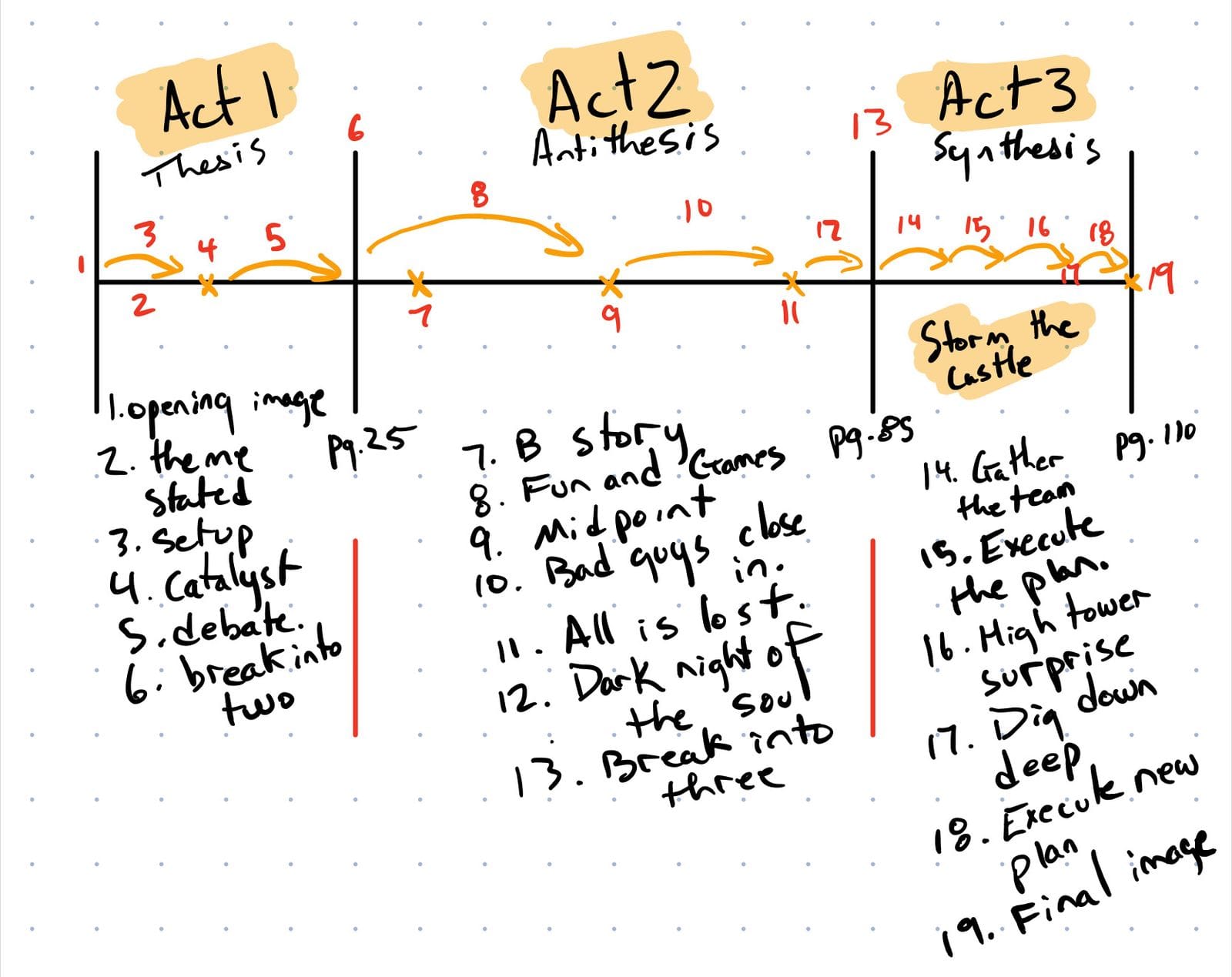
Blake Snyder’s Save the Cat (2005)
Snyder’s book Save the Cat became the industry standard guide for screenplay structure, building on Syd Field’s framework with much more specific detail.
With it, he brought:
- Detailed beat language - 19 specific beats with memorable names like “Fun and Games,” “All is Lost,” and “Dark Night of the Soul”
- Industry communication tool - gave producers and writers a common vocabulary to discuss story problems in development meetings
- Filled structural gaps - provided specific guidance for areas that Field and Vogler left vague (like “what exactly happens in pages 30-55?”)
Snyder’s approach made screenplay structure discussion more precise and accessible across Hollywood.
Television and Episodic Structures
Traditional Broadcast Structure
Traditional broadcast television fundamentally alters story structure due to commercial breaks. Unlike films that can build momentum continuously, TV shows must create multiple mini-climaxes and hooks to retain audiences through advertising interruptions. This changes both pacing and structural organization.
Television scripts also follow different page count conventions - a half-hour sitcom runs about 40-50 pages, while hour-long dramas typically use 60-70 pages, rather than the 1:1 page-to-minute ratio of feature films.
Broadcast structure elements work together:
- Teaser - A brief cold open that hooks the audience before the opening credits
- Acts - Multiple segments separated by commercial breaks. Sitcoms use 2-3 acts, dramas use 4-6 acts. Each act must end with a cliffhanger or springboard to pull viewers back.
- Tag - A short epilogue after the final commercial break
Example four-act drama:
- Teaser: Character discovers a problem
- Act One: Initial solution attempts → ends with complication
- Act Two: Dealing with complications → ends with stakes raised
- Act Three: Real problem revealed → ends with character in serious trouble
- Act Four: Final confrontation and resolution
- Tag: Loose ends tied up
This structure forces writers to think in terms of momentum and hooks rather than traditional three-act flow.
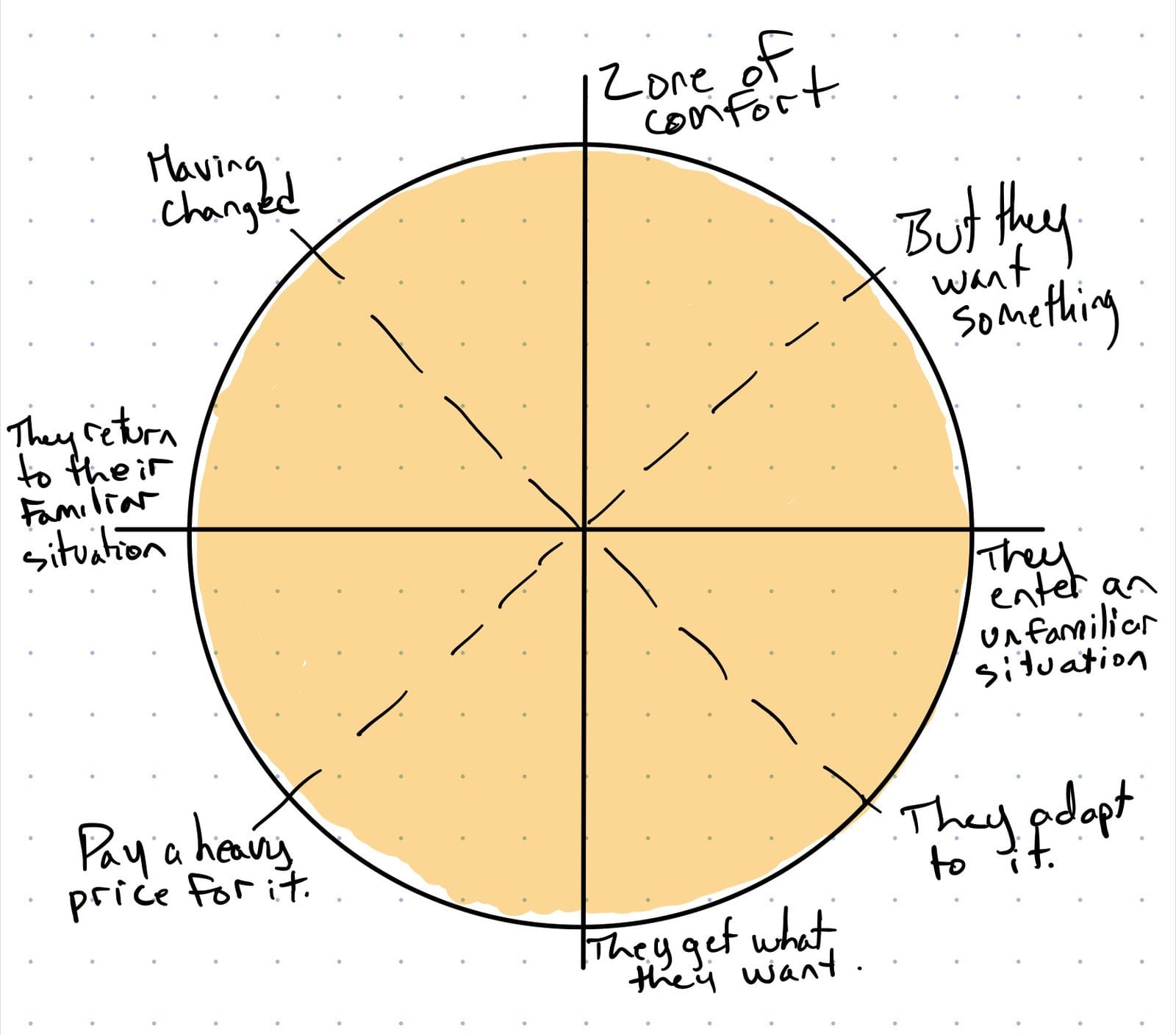
Dan Harmon’s Story Circle
Dan Harmon took Vogler’s Hero’s Journey and simplified it into eight beats for episodic television, demonstrating how mythic structure adapts to different storytelling needs.
This circular structure works perfectly for shows that need to reset while showing character growth episode by episode.
The Harold
From improv comedy and used in shows like Modern Family. Although much of it is word-of-mouth, the Improv Wiki states that the Harold alternates between individual storylines and group scenes that bring everyone together:
- Opening
- Scenes A1, B1, C1 - Three separate storylines
- Group Game - All storylines come together
- Scenes A2, B2, C2 - Storylines continue separately, developed further
- Group Game - Everyone together again
- Scenes A3, B3, C3 - Final development, often connecting the storylines
The A, B, C represent different thematic threads or situations that players explore, with characters moving between storylines during the group scenes.
Streaming’s New Rules
The moment you lose commercials, the structural rules change completely.
Streaming platforms like Netflix, Prime, and HBO can abandon traditional broadcast constraints entirely. This structural freedom opens up creative possibilities that would be impossible in traditional broadcast television.
Without the need to break every 8-15 minutes for advertisements, creators can return to classical filmmaking structures or experiment with entirely new forms—long single takes, non-linear timelines, or episodes that vary dramatically in length and pacing.
Alternative Approaches
Robert McKee's Story Spectrum
In his influential book Story, McKee identified three fundamental approaches to story structure, forming a triangular spectrum of possibilities. Rather than rigid categories, this triangle works as a spectrum where stories can position themselves anywhere based on which elements they emphasize.
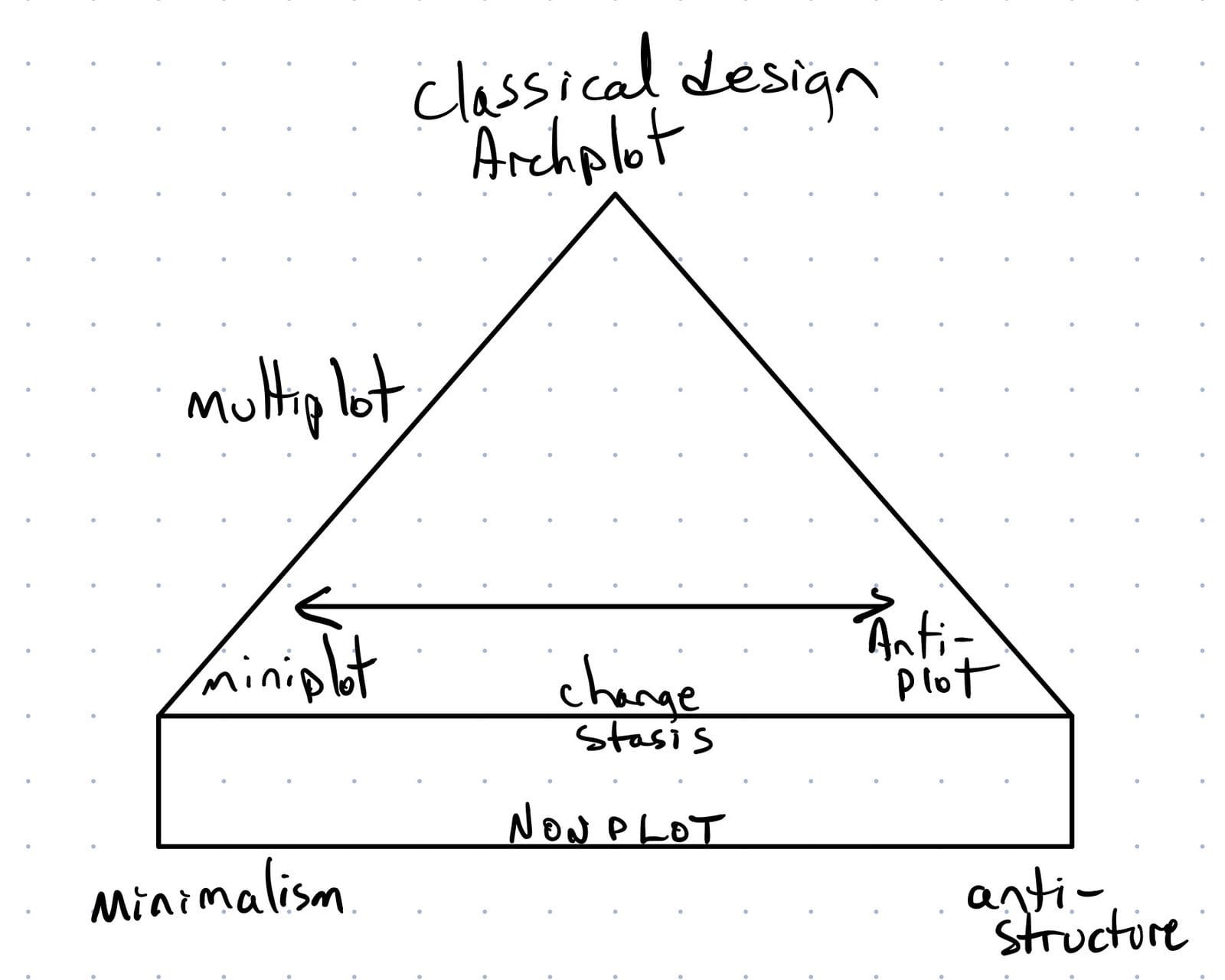
Classical Design (Archplot): Stories that lean toward this corner tend to feature elements like causality, closed endings, linear time, external conflict, single protagonists, consistent reality, and active protagonists.
Minimalism (Miniplot): Stories moving toward this approach often incorporate open endings, internal conflict, multiple protagonists, and passive protagonists.
Anti-Structure (Antiplot): Stories shifting in this direction typically use coincidence, nonlinear time, and inconsistent realities.
The closer your story moves toward one corner, the more it emphasizes those particular storytelling techniques. Most stories blend elements from different approaches, finding their place somewhere within the triangle rather than at its corners.
McKee also identified Nonplot - films that “dissolve into portraiture” and fall outside the story triangle entirely. These works “inform us, touch us, and have their own rhetorical or formal structures” but “do not tell story.”
McKee showed that structural choices aren’t just technical decisions but artistic statements about how the world works.
Other Forms
The structural approaches we've covered represent only a small selection of available screenplay formats. These primarily Western, Hollywood-influenced frameworks have dominated mainstream film and television.
Many other storytelling traditions and approaches exist, including:
- Kishotensketsu (Japanese four-act: Introduction → Development → Twist → Conclusion, no conflict required)
- Essay development patterns (increasing importance, complexity, comparison/contrast, cause-and-effect, etc.)
- Circular/spiral structures from various cultures
- Collective narratives that follow groups rather than individuals
- Episodic structures without overarching plots
- Stream of consciousness approaches
- Modular storytelling (separate pieces that connect thematically)
- Multiple timeline structures
- Anthology formats
Building your own story bridge
Remember that the structural approaches we've discussed here have worked successfully in the past, but they can also be adapted and built upon for your specific needs.
The landscape of story structure is vast and constantly evolving. The approaches above give you a foundation, but countless others are waiting to be discovered or invented.
Experiment and discover what works for you.
Key Takeaways
- Multiple structural approaches exist - and there are many more beyond what we’ve covered here
- Each approach serves different storytelling needs - figure out what works best for your story
- Understanding your story’s core idea is essential - know what you’re trying to achieve
- Structure is about intentional organization - make conscious choices about how to arrange your story
- No formulas or rules - it’s about finding the right approach for what you’re trying to accomplish